BLACK FRIDAY UP TO 75% OFF + FREE GIFTS
MONEY-BACK GUARANTEE
BLACK FRIDAY UP TO 75% OFF + FREE GIFTS
MONEY-BACK GUARANTEE
BLACK FRIDAY UP TO 75% OFF + FREE GIFTS
MONEY-BACK GUARANTEE


Most people prepare for an emergency by buying extra bottled water and flashlight batteries.
They assume that as long as they have their smartphone in their pocket, they are connected. They assume Google, text messaging, and emergency dispatch will tell them what is happening and where to go.
Here is the truth modern emergency planners understand:
Your smartphone is only as reliable as the electrical grid powering the nearest cellular tower.
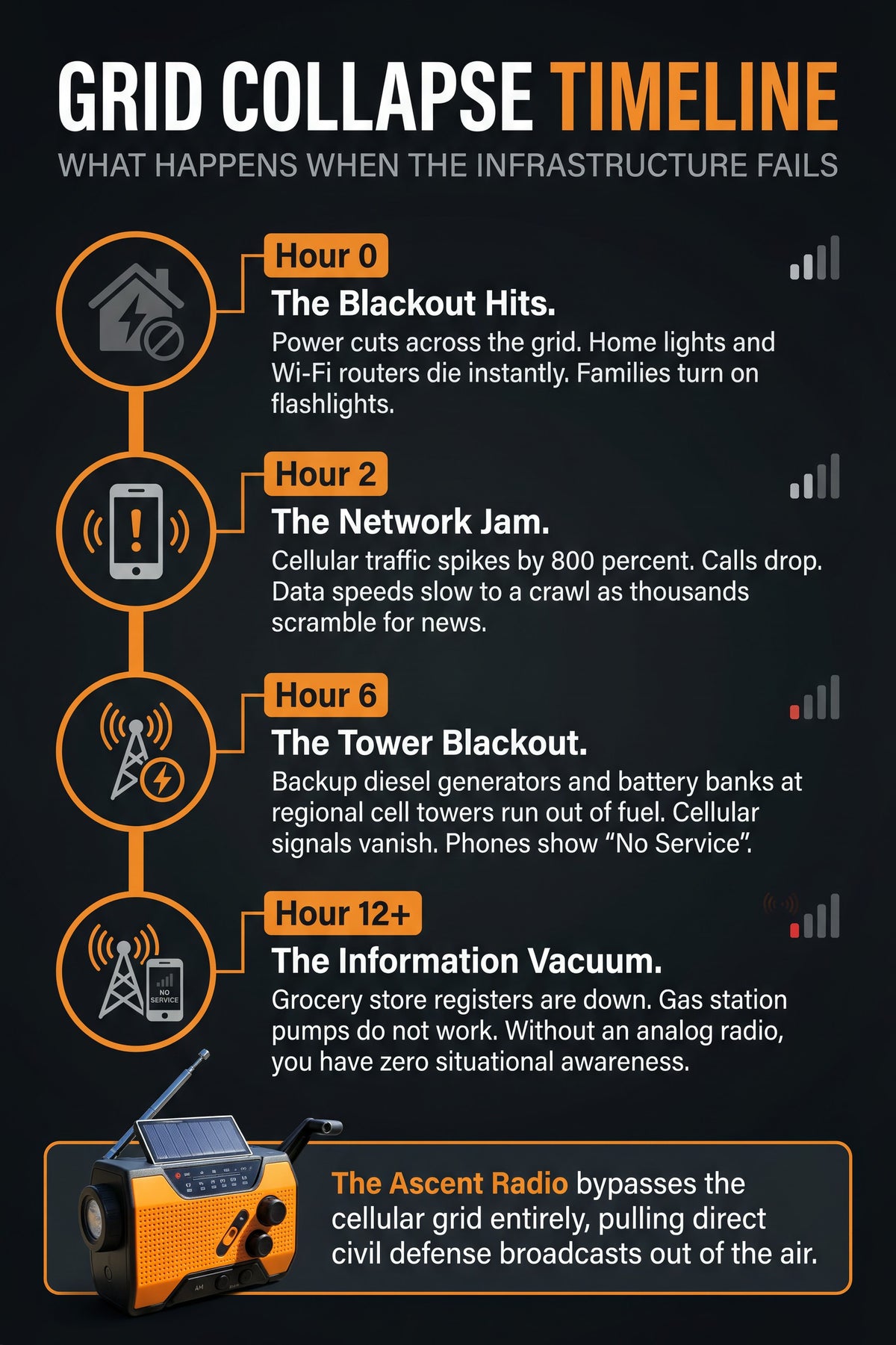
During severe storms, regional blackouts, substation failures, or infrastructure attacks, cell towers become overwhelmed within minutes. Within 4 to 8 hours, backup diesel generators at those towers run out of fuel. When that happens, your 1,200-dollar smartphone instantly transforms into a useless piece of dark glass.
You are cut off.
In a crisis, information is not a convenience. Information is the difference between panic and survival.
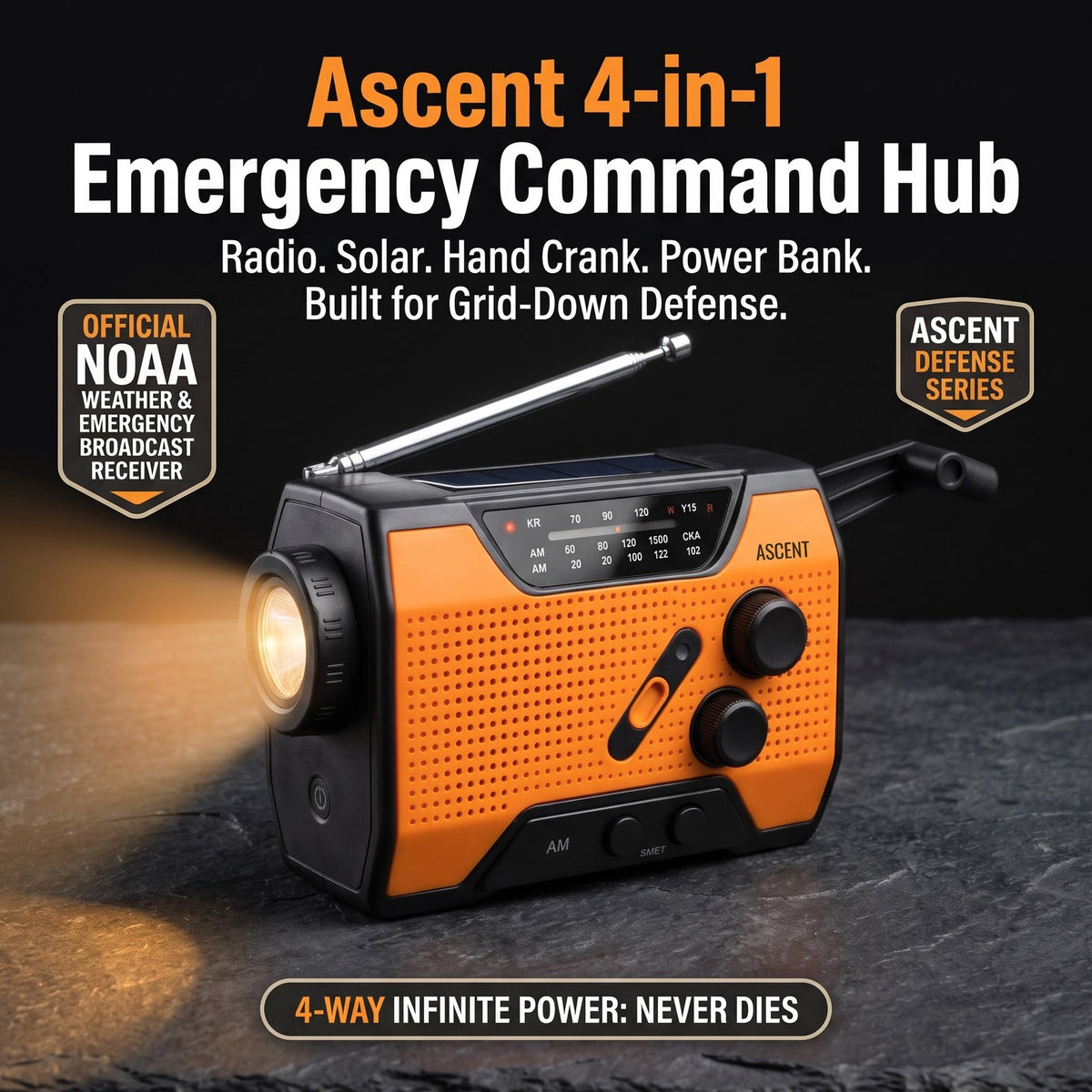
The Ascent Tactical Emergency Radio puts complete situational control back into your hands, completely offline, with zero dependence on the electric grid.
The Ascent Emergency Radio was engineered from the ground up for one mission: guaranteed functionality when modern municipal utilities collapse.
It does not require a wall socket. It does not require fresh double-A batteries. It does not require an internet connection, a cell signal, or an app.
It combines the three non-negotiable pillars of field survival into one rugged, portable command hub:
Pillar 1
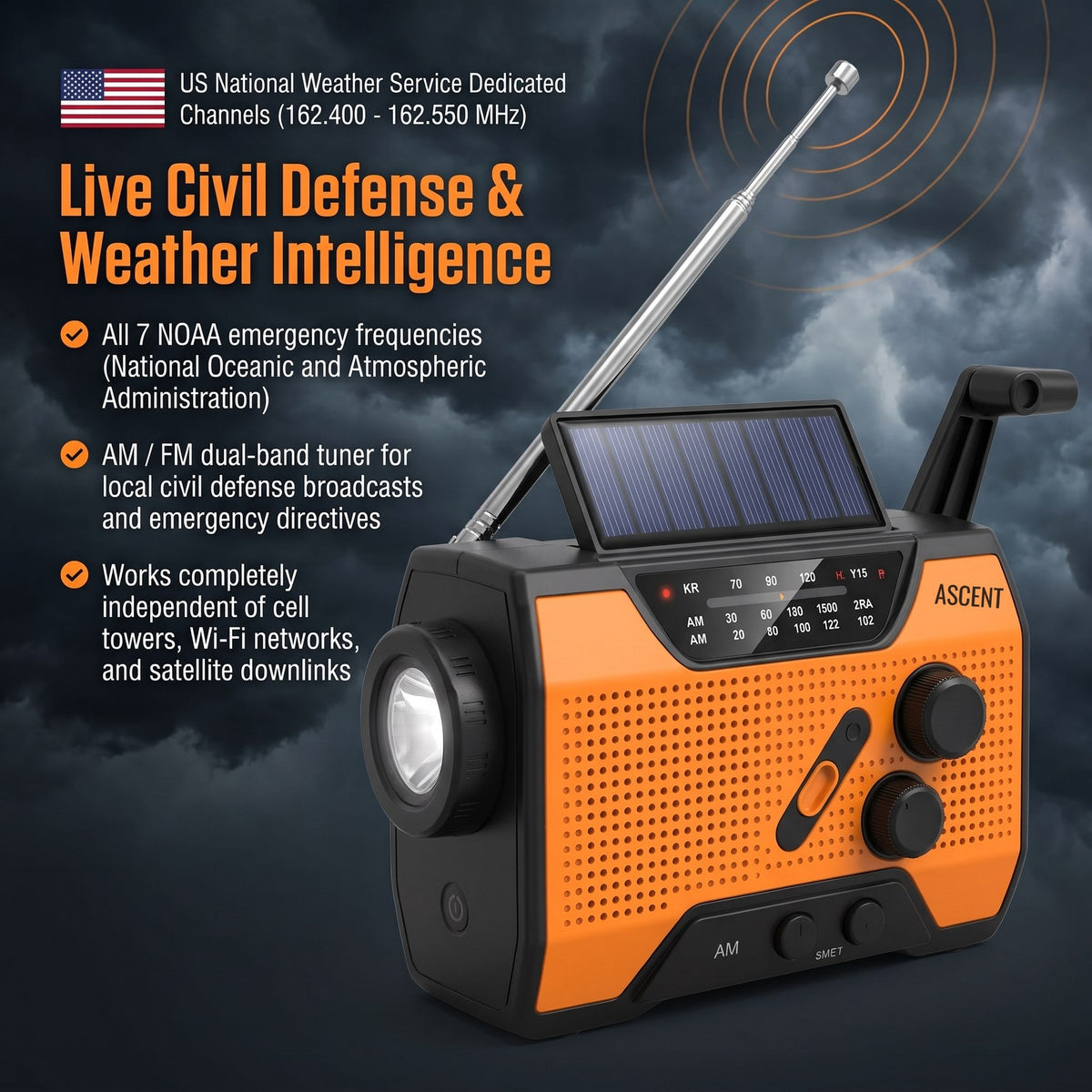
Receive official National Oceanic and Atmospheric Administration (NOAA) emergency broadcasts, civil defense announcements, and AM/FM radio stations on dedicated analog airwaves that never go down.
Pillar 2
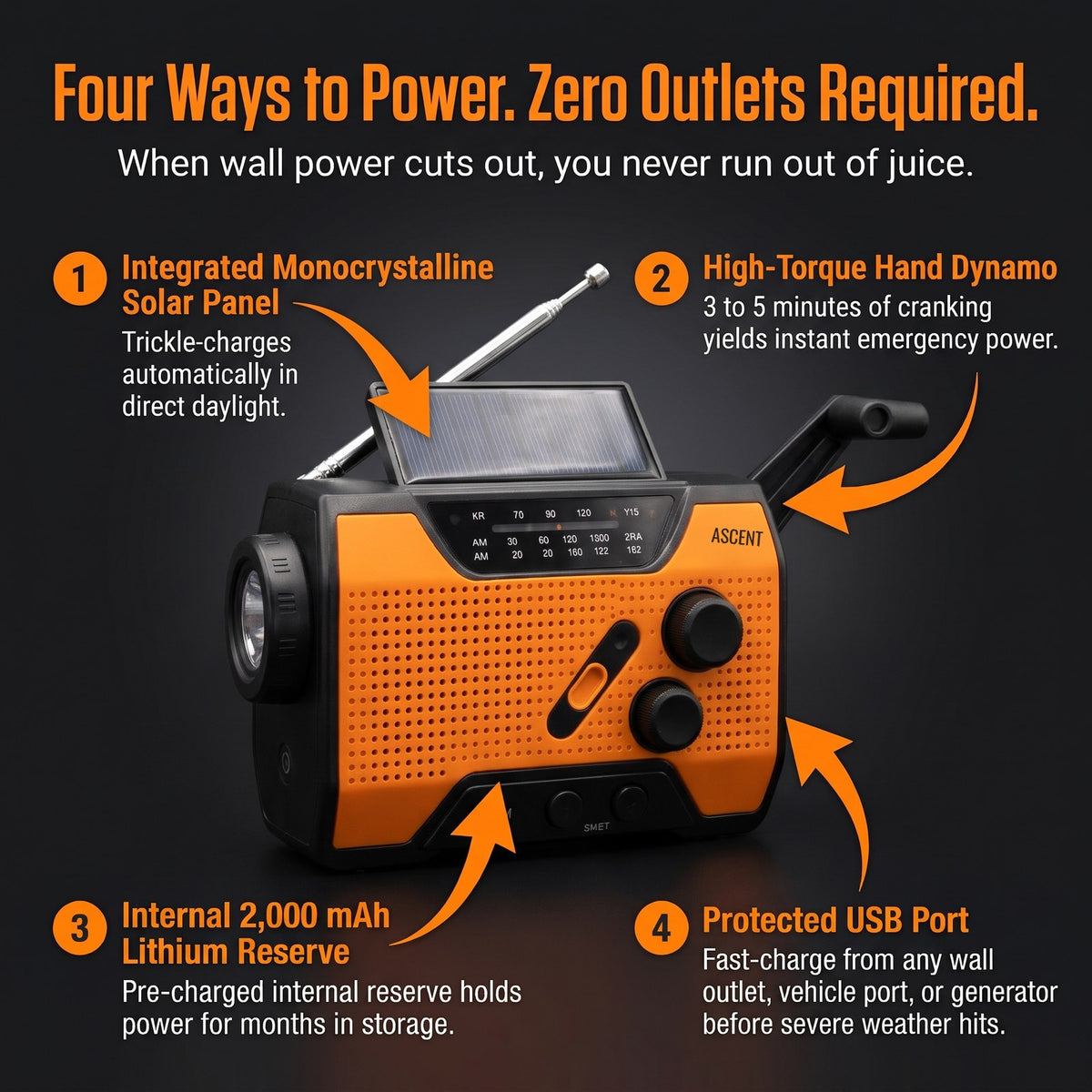
Four independent power methods ensure this unit can never be permanently dead, even if it has sat inside a dark glovebox for two years.
Pillar 3
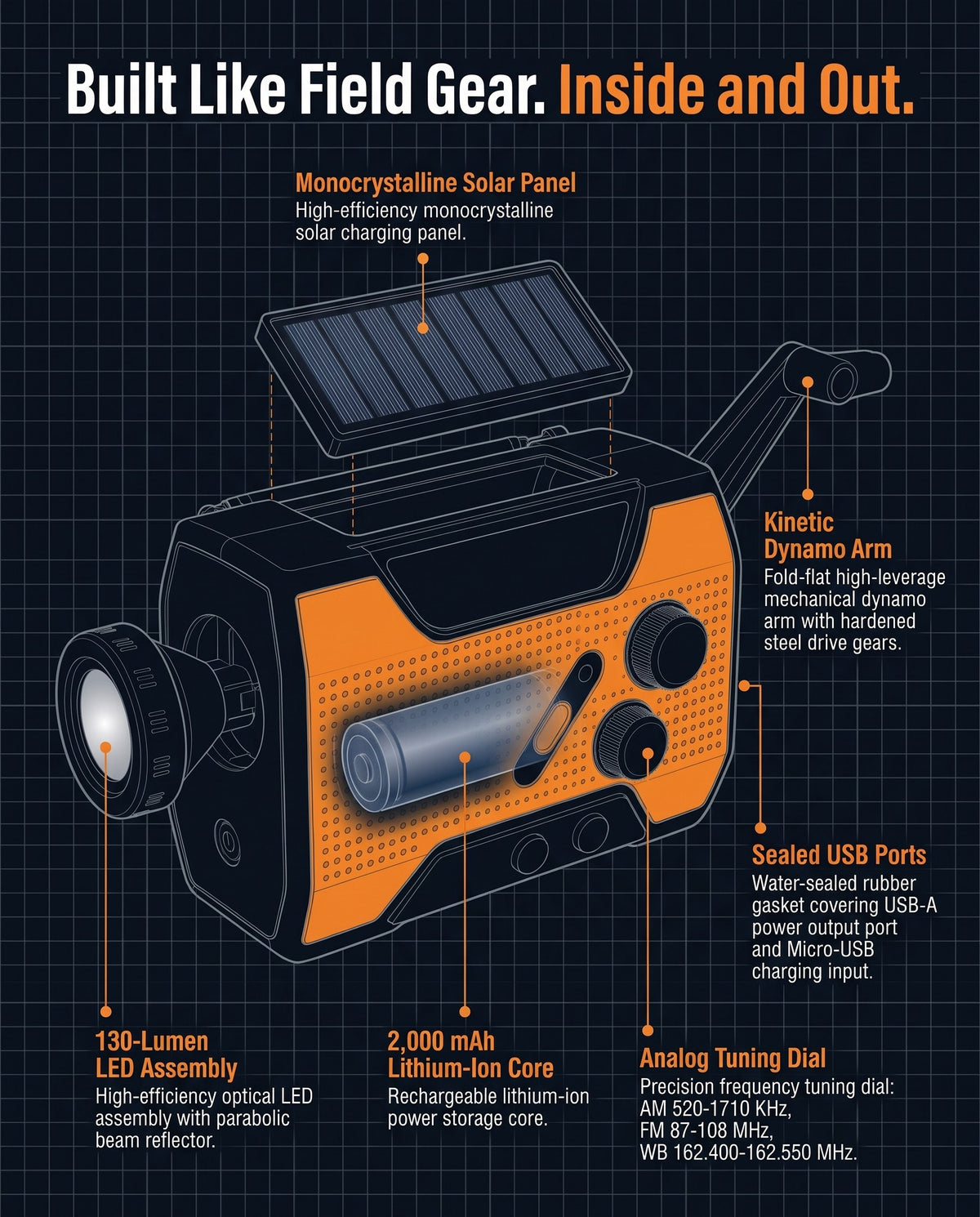
A high-output USB charging port breathes immediate life back into dead smartphones, while an integrated 130-lumen wide-beam LED spotlight and audible SOS distress beacon ensure you are never stranded in the dark.
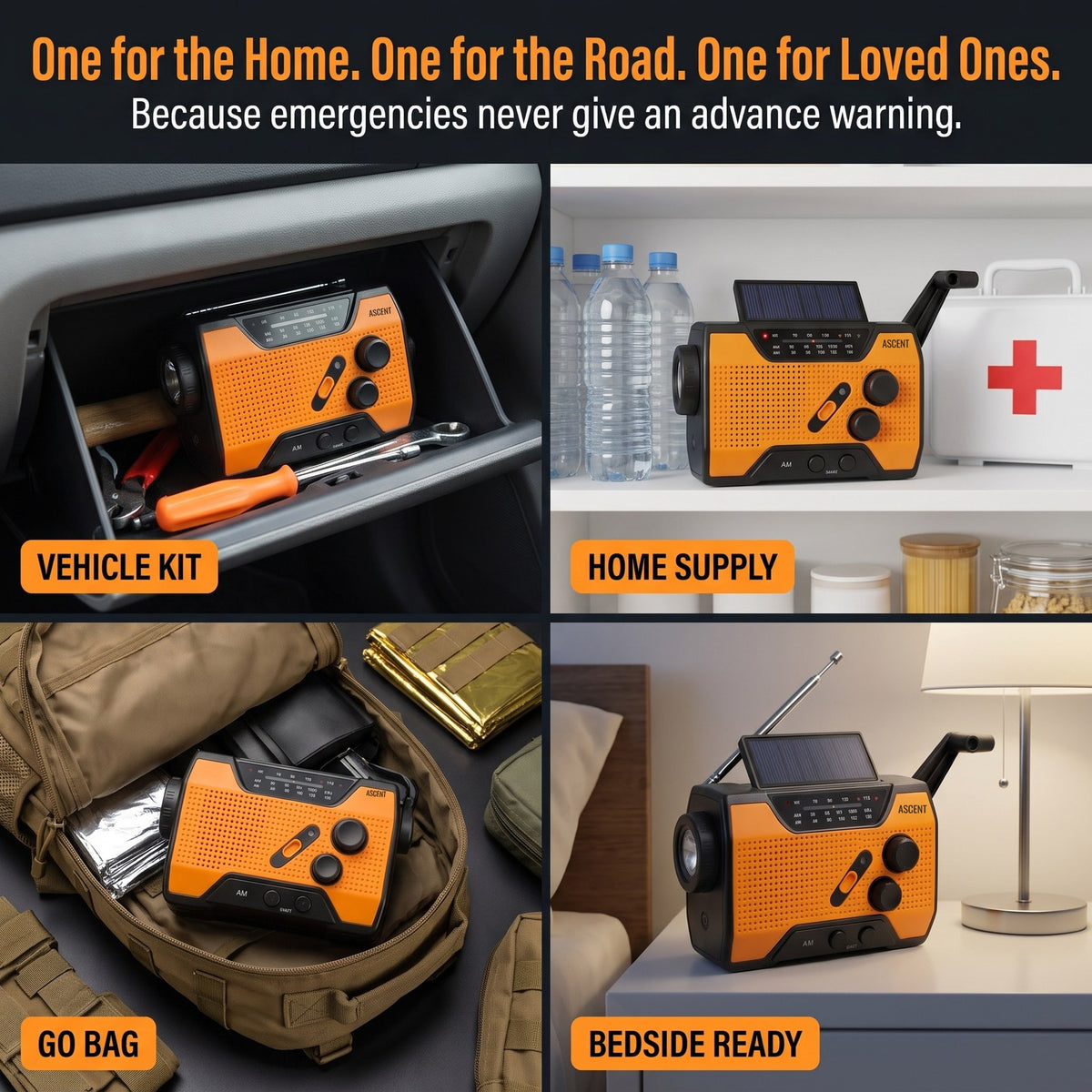
Simple enough that an eight-year-old child or an elderly parent can operate it within seconds: no complicated menus, no touchscreens, just direct physical switches that work under high stress.
The fatal flaw of most emergency gear is battery dependency. When a crisis strikes, the average homeowner discovers their flashlights are dead, the batteries in the drawer have leaked acid, and local retail stores are completely sold out within an hour.
The Ascent Emergency Radio is engineered so it is physically impossible to be left without power.
Power Source 1
When every battery on earth is dead, mechanical kinetic energy still works. Unfold the reinforced rear crank and spin it for 3 to 5 minutes. That single mechanical input generates enough direct power for 4 to 8 minutes of live emergency radio broadcast or high-lumen light.
Power Source 2
Leave the radio on a sunny windowsill, porch, or car dashboard. The top-mounted solar array passively trickle-charges the internal battery all day long, ensuring a continuous passive energy top-off without touching a switch.
Power Source 3
Before a forecasted blizzard, hurricane, or severe weather event, plug the unit into any standard USB wall block, computer, or vehicle port. In just a few hours, the internal battery reaches 100 percent capacity, ready to ride out extended outages.
Power Source 4
A high-density lithium-ion battery sits inside the sealed core. It holds its charge over long storage periods, acting as both an internal fuel tank for the radio and a mobile power bank for external devices.
When local television stations go off the air and mobile cell data is severed, where do emergency orders come from?
They come from the National Oceanic and Atmospheric Administration (NOAA) National Weather Radio network: a federally protected radio broadcast system operated 24 hours a day, 7 days a week, 365 days a year across the United States.
The Ascent Emergency Radio features an analog tuner tuned across all 7 NOAA frequencies, plus standard AM and FM bands:
Immediate warnings on severe weather, tornadoes, flash floods, hurricanes, and winter storms.
Boil-water advisories, chemical spill evacuation notices, nuclear or power grid disruptions, and state-level emergency declarations.
Picks up faint analog signals from distant broadcast towers even in deep valleys, heavily wooded regions, or concrete residential basements where cell phones register zero bars.
You simply extend the reinforced antenna, select your frequency band, turn the analog dial, and instantly hear clear, unfiltered instructions from emergency coordinators.
An emergency radio that only plays audio leaves half the survival equation unsolved. The Ascent unit is built as an active field utility:
01
In a crisis, a dead phone cuts off your ability to reach loved ones who may be miles away.
Plug your phone's charging cable directly into the Ascent radio's weather-sealed USB output. The 2,000 mAh battery immediately transfers juice into your device, delivering enough battery life to send critical text messages, share emergency GPS coordinates, or make the one phone call that matters most.
02
Candles are fire hazards in a home with children or gas leaks. Cheap flashlights burn through disposable batteries in two hours.
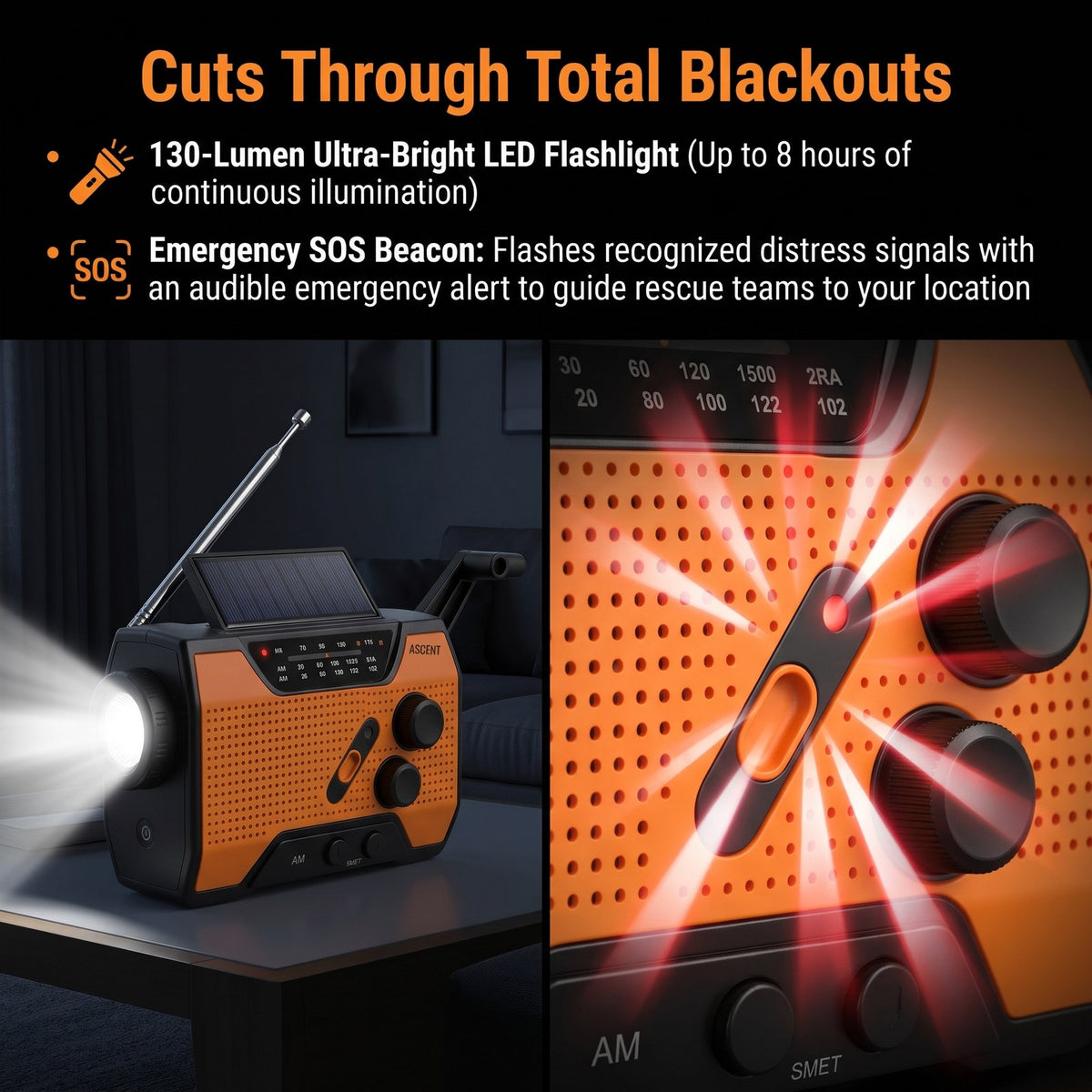
The Ascent radio features an ultra-efficient 130-lumen LED emitter engineered with a wide-angle parabolic reflector. It casts a wide, bright beam capable of lighting up an entire family living room, attic, or dark roadside shoulder for up to 8 continuous hours on a single charge.
03
If you are trapped in a disabled vehicle, stranded on a remote trail, or caught in floodwaters, shouting for help exhausts your lungs in minutes.
Flipping the tactical SOS switch activates a piercing, high-decibel acoustic alarm paired with a high-frequency visual light strobe. This standardized rescue signal cuts through wind, rain, and distance, guiding first responders directly to your exact coordinates without vocal strain.

Direct Comparison Matrix
| Critical Survival Feature | The Ascent Tactical Radio | Standard Amazon Cheap Clones | Relying on Your Smartphone |
|---|---|---|---|
| Power Dependency | 4-Way Infinite Power (Crank, Solar, USB, Battery) | Fragile crank that snaps; requires fresh AA batteries | 100% dependent on wall grid or dead car battery |
| Cell Tower Vulnerability | 0% (Receives direct analog airwaves) | Partial (Often lacks dedicated NOAA emergency bands) | 100% (Useless when regional towers lose power) |
| NOAA Government Weather Channels | All 7 dedicated emergency bands factory calibrated | Usually AM/FM only; no dedicated civil defense alerts | Requires live 5G/LTE data connection |
| Device Charging Capability | Integrated 2,000 mAh USB bank to revive dead phones | Often no output port, or low-voltage port that errors out | Cannot charge anything; drains rapidly in cold |
| Illumination Source | 130-Lumen LED spotlight with SOS beacon (8-hour runtime) | Dim 20-lumen bulb; drains main battery in 30 minutes | Screen flashlight burns remaining 10% battery instantly |
| Water & Weather Rating | IPX-3 rated (Resists heavy rain, splashes, and storms) | Unsealed seams; short-circuits in light rain | Highly fragile; water damage voids internal circuits |
| Cold Storage Shelf Life | Holds charge for months; hand crank provides instant reboot | Drains completely in weeks; useless without fresh batteries | Lithium cell dies quickly in cold gloveboxes |
We believe in radical engineering transparency. We do not inflate numbers or promise miracles. Here is the verified technical spec sheet for the Ascent Tactical Emergency Radio:
Field Storage Notice
To maintain maximum battery health, plug the unit into a USB port to top off the charge every 4 to 6 months. However, if an emergency catches you completely off guard and the battery is fully drained, unfolding the hand crank and spinning for 3 minutes brings the radio and flashlight immediately back online.

The Ascent 30-Day Field Readiness Guarantee
We do not want you to take our word for it. When your Ascent Tactical Emergency Radio arrives at your doorstep, take it out of the box and run your own inspection.
Unfold the antenna and tune into your local NOAA station. Turn on the flashlight and test the high-lumen beam in a dark hallway. Plug your phone into the USB port and watch the charging bolt appear. Give the hand crank a few turns and feel the mechanical dynamo engage.
If you do not feel 100 percent confident that this device will protect and inform your family during an unexpected crisis, simply contact our support team within 30 days of delivery. We will issue an immediate, courteous refund with zero hassle.
You either hold the most reliable emergency command hub in your hands, or you pay nothing. That is the Ascent commitment.